In a 2026 European market-surveillance campaign, 49 of the 132 clothing items tested — 37% of the sample — did not accurately report their fibre composition.
As the European Union prepares to introduce Digital Product Passports for textile apparel, this finding raises a practical question for companies: how will the new digital requirements interact with the information already required on physical textile labels?
Regulation (EU) No 1007/2011, commonly referred to as the Textile Labelling Regulation, establishes the current EU rules for indicating the fibre composition of textile products.
It applies to textile products and to certain products or components containing at least 80% textile fibres by weight. Its purpose is to ensure that consumers receive consistent information about what textile products are made of across the European market.
The manufacturer is responsible for providing accurate fibre-composition information. Where the manufacturer is established outside the EU, this responsibility falls to the importer. Distributors must also ensure that products carry the required information when they are placed on the market.
The regulation does not harmonise every element commonly found on a garment label. In particular, it does not establish EU-wide rules for size labelling, country of origin or washing and care instructions.
The European Commission’s 2026 market-surveillance campaign found that 37% of the clothing items tested did not accurately report their fibre composition. Among products purchased online, the non-compliance rate reached 46%.
Authorities identified incorrect fibre percentages, the presence of fibres different from those declared and the use of fibre names that did not comply with the regulation. Their actions included stopping sales, requesting corrections and requiring products to be relabelled.
This is not only a label-design issue. It concerns whether companies can obtain accurate composition information, substantiate it and maintain consistency across suppliers, product systems, physical labels and online sales channels.
Moving textile information from a physical label to a Digital Product Passport does not make the underlying data more accurate. It makes the quality, traceability and governance of that data even more important.
Under the rules currently in force, the answer is no. Publishing information on an e-commerce page or through a Digital Product Passport does not remove the physical labelling obligations established by Regulation (EU) No 1007/2011.
The future relationship between physical and digital information will depend on two separate regulatory processes: the Textile ESPR Delegated Act, which will define the Digital Product Passport requirements for textile apparel, and the planned revision of the Textile Labelling Regulation.
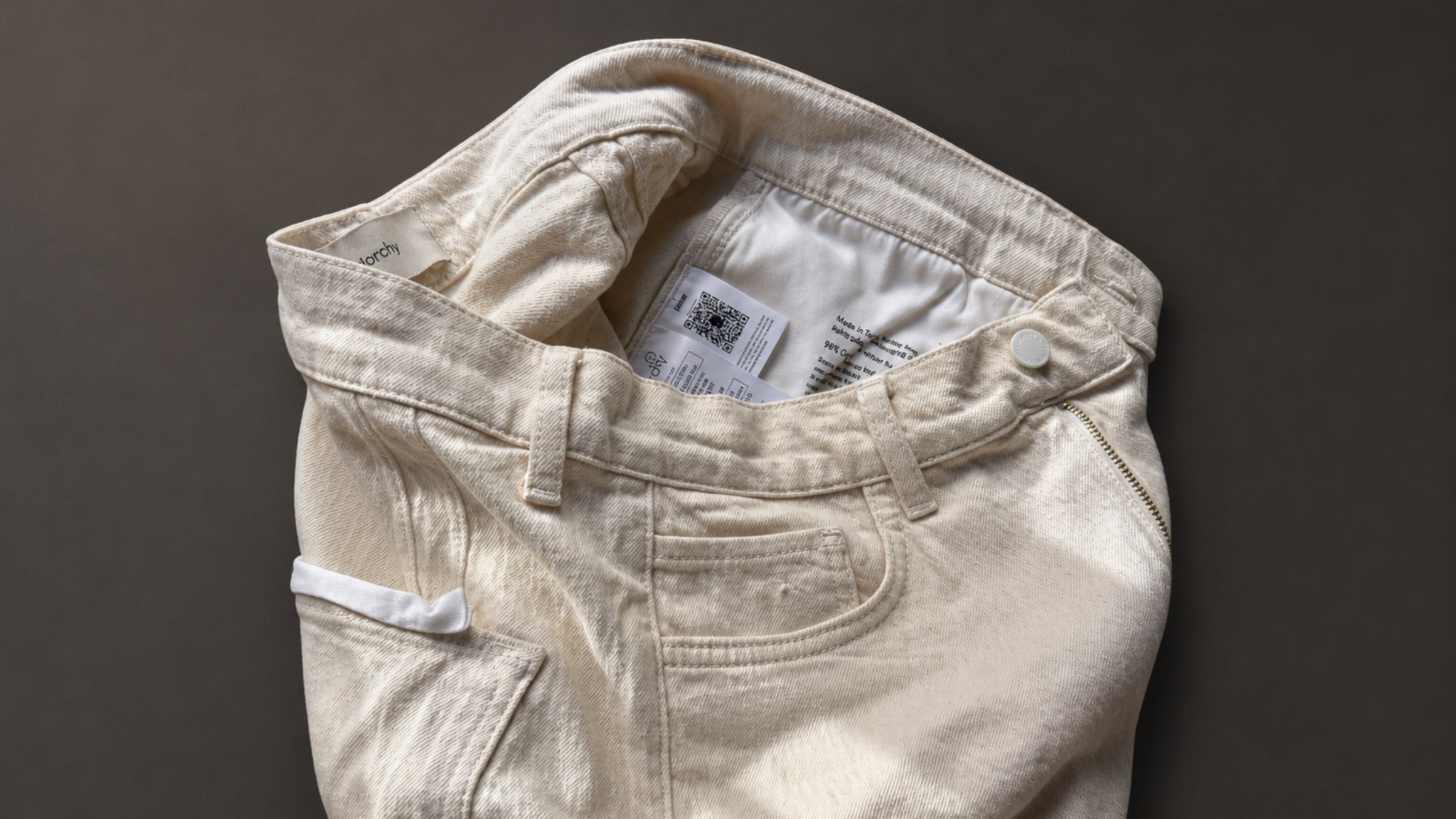
Under the current Textile Labelling Regulation, companies must provide information including:
The information must be durable, easily legible, visible and accessible. It must also be provided in the official language or languages required by the Member State in which the product is made available to consumers.
When a label is used, it must be securely attached to the product. Fibre-composition information must also be clearly visible before purchase, including when the product is sold online.
The European Commission’s textile-apparel DPP page identifies possible categories of information such as:
These categories should not yet be treated as the final mandatory textile dataset. The Textile ESPR Delegated Act will determine which data must be included, the required level of granularity, who can access each type of information and when the obligations begin to apply.
Fibre composition may therefore appear in both the physical label and the Digital Product Passport. The practical objective should be to manage it as a single approved dataset that can be used consistently across labels, e-commerce pages, compliance documentation and the DPP.
The European Commission is reviewing Regulation (EU) No 1007/2011 to assess whether the current framework remains appropriate and how it should interact with new digital product-information requirements.
The review considers greater coordination between physical and digital information, more harmonised requirements across the EU and the possibility of covering additional categories of textile information. It may also help reduce duplication between labels, product documentation and future Digital Product Passports.
The Commission’s 2025 Single Market Strategy identifies digital labelling, including access through QR codes, as a longer-term route for simplifying product information while retaining essential information on the physical product.
This indicates a policy direction rather than an adopted division between physical and digital requirements. As of November 2026, the proposal revising the Textile Labelling Regulation has not been published, and the existing rules remain in force.
The ESPR allows the European Commission to introduce labels displaying product-performance classes when these are established through product-specific delegated acts. Such a label would be distinct from both the current textile composition label and the Digital Product Passport.
An October 2026 Draft Final Report prepared for the European Commission tested three ESPR label prototype frameworks with 6,104 consumers across five product categories, including apparel.
Based on the results, the study recommends a common label architecture combining an overall ecodesign rating, selected product-specific indicators and a QR code providing access to further information and the Digital Product Passport.
For apparel, the experiment used environmental footprint, robustness and recycled content as test parameters. These indicators were selected for the study and should not be interpreted as adopted requirements for a future textile label.
The recommended layout has not been adopted by the European Commission, and the report does not establish an ESPR label requirement for textiles. It nevertheless shows how three separate instruments could eventually work together:
Companies should not redesign their physical labels around requirements that have not yet been adopted. They can, however, prepare the information systems that will need to support both existing and future obligations.
The immediate priority is to ensure that fibre-composition data is accurate, approved and consistently connected with the correct product. The same principle applies to origin, operator, durability, repair and recycling information as these datasets become part of future textile requirements.
Physical labels, e-commerce pages, compliance documentation and Digital Product Passports should draw from one reliable product-data foundation. This reduces inconsistencies, makes future regulatory changes easier to implement and allows information to be reused without maintaining separate versions for each channel.
Renoon supports fashion companies in structuring product and supply-chain data, connecting existing systems and preparing Digital Product Passports that can evolve alongside EU textile requirements.