
.avif)
This article reflects the current status and is updated as new regulatory developments are released. Last updated: September 2026.
The European Digital Product Passport framework is moving from the definition of its common legal and technical foundations towards sector-specific implementation.
The EU Digital Product Passport Registry became operational in July 2026, CEN and CENELEC have published all eight European DPP standards, and new technical resources are becoming available to support implementation.
Most companies are not yet subject to a Digital Product Passport obligation. The specific requirements for individual product groups, including textiles, will be established through product-specific delegated acts.
This article tracks the main regulatory and technical developments. The latest updates appear first, followed by the upcoming milestones and the actions organisations can begin taking today.
To track monthly and as-they-happen updates, request access to the Newstracker.
CEN and CENELEC have now published all eight European standards developed to support the Digital Product Passport system.
The final two standards (EN 18239 and EN 18246) cover:
Their publication completes the technical framework developed by CEN and CENELEC for Digital Product Passports. Together, the eight standards cover data carriers, unique identifiers, interoperability, data exchange, storage, APIs, access rights, security and data integrity.
Important to note: publication by CEN and CENELEC is distinct from formal citation in the Official Journal of the European Union.
The European Commission referenced the first six standards in July 2026 through Implementing Decision (EU) 2026/1736. DPP systems applying these standards can benefit from a presumption of conformity with the corresponding ESPR requirements.
The Commission’s official Digital Product Passport timeline indicates that a separate implementing decision referencing the remaining two standards is expected in the following weeks. Once published in the Official Journal, this will complete their formal recognition as harmonised standards under the ESPR.
The Commission also released version 3 of its Registry User Guide for Economic Operators in September, providing updated operational guidance for organisations preparing to interact with the Registry.
The European Commission published updated guidance for Digital Battery Passports in August 2026, including a revised mapping of the data points required for different battery categories.
This guidance supports preparation for the first mandatory Digital Product Passports under EU legislation. From 18 February 2027, an electronic battery passport will be required for each light means of transport battery, industrial battery with a capacity greater than 2 kWh, and electric vehicle battery placed on the EU market.
The update is also relevant beyond the battery sector. It provides an early example of how the common Digital Product Passport architecture can be translated into sector-specific data requirements and implementation guidance.
On 16 July 2026, the European Commission adopted Commission Implementing Regulation (EU) 2026/1778, establishing the implementation arrangements for the Digital Product Passport Registry.
The Registry became operational on 20 July 2026.
It does not store the complete data contained in Digital Product Passports. Instead, it provides the shared EU infrastructure for registering unique identifiers and the mandatory registration data associated with each passport. It also supports validation, proof of registration and passport discovery.
The complete product information remains decentralised and is made available by the responsible economic operator or its Digital Product Passport service provider.
The Commission has also introduced a dedicated portal containing access to the Registry, a testing environment, user guides, technical documentation and Help Desk support.
On 14 July 2026, the European Commission adopted Implementing Decision (EU) 2026/1736, referencing the first six harmonised standards supporting Digital Product Passports under the Ecodesign for Sustainable Products Regulation.
They cover:
Digital Product Passport systems applying the referenced standards can benefit from a presumption of conformity with the corresponding ESPR requirements.
Together with the Registry, these standards provide a common technical foundation for building interoperable Digital Product Passports across different sectors and systems.
All eight European DPP standards: Published by CEN and CENELEC.
First six harmonised DPP standards: Referenced in the Official Journal in July 2026.
Remaining two DPP standards: Published by CEN and CENELEC, with formal EU reference expected in September 2026.
EU Digital Product Passport Registry: Operational since 20 July 2026.
Registry Implementing Regulation: Adopted in July 2026.
ESPR Working Plan: Adopted in April 2025.
Product-specific delegated acts: In preparation according to product group.
First mandatory Digital Product Passports: Applicable from 18 February 2027 for specified battery categories.
The horizontal legal framework, Registry and complete set of European technical standards have therefore been established. Some horizontal measures remain under development, while the requirements applying to individual product groups will be defined through sector-specific legislation and delegated acts.
The next major phase will be the adoption of product-specific delegated acts under the ESPR.
These measures will determine:
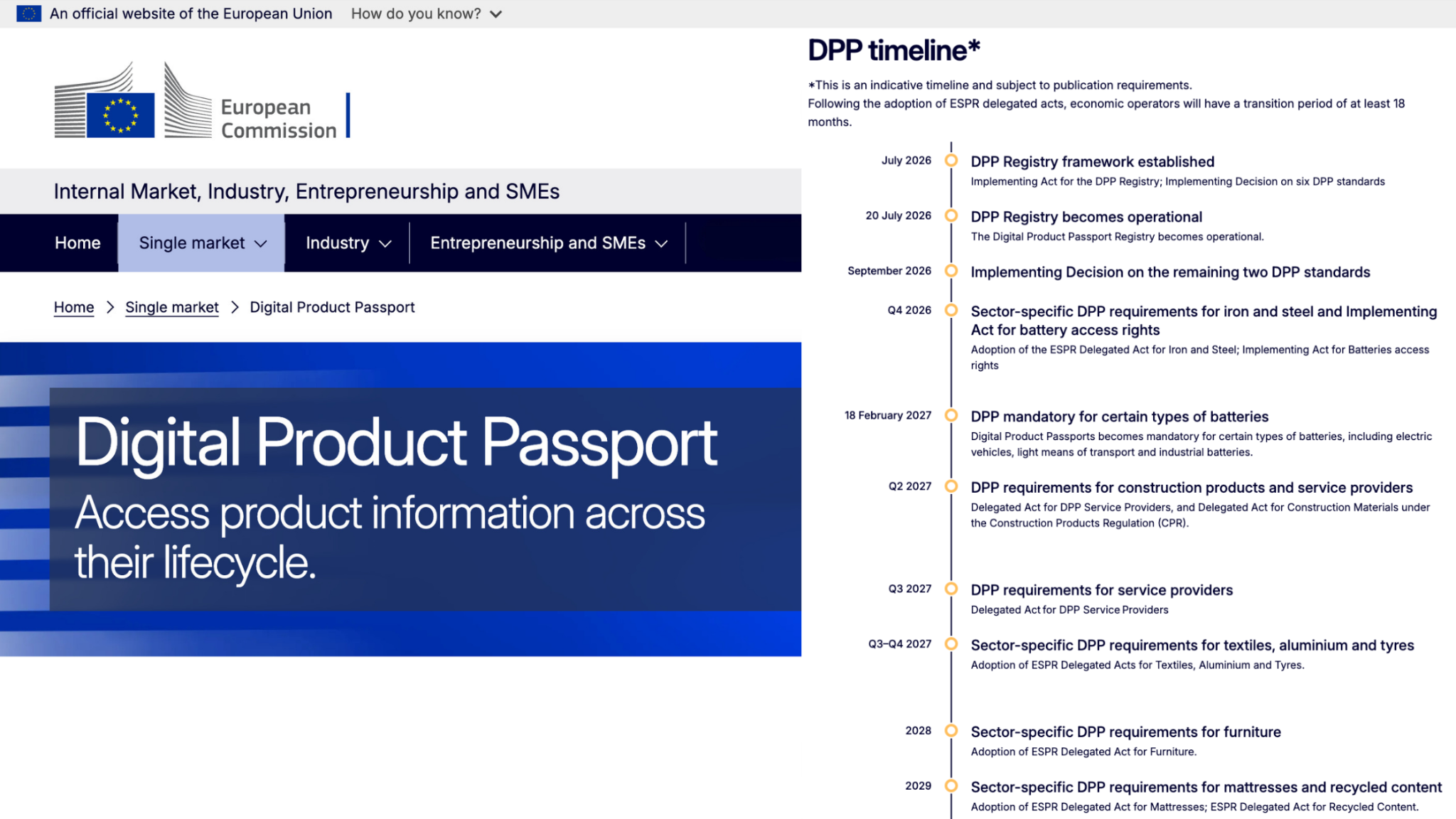
The current European Commission timeline indicates the following sequence.
Q4 2026: Delegated act for iron and steel.
Q4 2026: Battery Passport implementing act on access rights.
18 February 2027: Mandatory Digital Battery Passports for specified battery categories.
Q3 2027: Delegated act establishing requirements for DPP service providers.
Q3–Q4 2027: Delegated acts for textiles, aluminium and tyres.
2028: Delegated act for furniture.
2029: Delegated act for mattresses.
These dates are indicative and may change as the preparatory work progresses. For measures adopted under the ESPR, economic operators will generally have a transition period of around 18 months between the adoption of a delegated act and its application.
The ESPR establishes the horizontal framework for Digital Product Passports, but it is not the only piece of EU legislation introducing or referring to them.
Digital Product Passport provisions also appear in EU legislation covering:
The Batteries Regulation will be the first to make Digital Product Passports mandatory, beginning in February 2027 for specified battery categories.
The Construction Products Regulation, Toy Safety Regulation and Detergents and Surfactants Regulation also establish or introduce product-level digital information systems based on common Digital Product Passport principles.
Each legislative instrument defines the information and obligations relevant to its product groups. Wherever possible, however, the Registry, identifiers, registration mechanisms and technical standards are intended to provide common infrastructure across these different frameworks.
Product-specific datasets are still being defined, but organisations do not need to wait for the final delegated acts before beginning their preparation.
Current developments provide enough direction to start:
These activities are largely independent of the final dataset established for each product category. Starting early can expose gaps in systems, data quality and supplier processes before the obligations begin to apply.
The Digital Product Passport framework will continue to evolve.
The next developments to monitor include the formal EU reference of the final two standards, the delegated act for iron and steel, the battery access-rights rules and the legislation establishing requirements for Digital Product Passport service providers.
The Renoon Digital Product Passport Newstracker provides a monthly analysis of regulatory and technical developments, explaining what has changed, why it matters and what organisations should prepare next.
Explore the latest public editions and request access to upcoming releases.


.avif)


.png)