
.avif)
.avif)
The Corporate Sustainability Reporting Directive (CSRD) is the European Union’s framework for standardised sustainability reporting.
It requires companies to disclose structured information on environmental, social, and governance (ESG) matters, making sustainability data more comparable, reliable, and accessible.
This guide explains what CSRD is, who it applies to, what companies must report, and how it is implemented in practice.
The Corporate Sustainability Reporting Directive (CSRD) is an EU directive adopted in 2022 to strengthen corporate sustainability reporting requirements.
It replaces and significantly expands the previous Non-Financial Reporting Directive (NFRD), increasing both the number of companies in scope and the level of detail required in disclosures.
The objective is to ensure that companies provide consistent, comparable, and reliable sustainability information, enabling investors, regulators, and other stakeholders to assess their impact and performance.
CSRD changes the role of sustainability reporting.
It is no longer a voluntary or narrative exercise.
It becomes a structured, standardised, and auditable system of disclosure.
Companies are required to report not only on what they do, but on:
This marks a shift from communication to corporate-level accountability, where sustainability information must be supported by verifiable data.
CSRD applies progressively to a broad range of companies.
It covers:
Compared to the NFRD, this significantly expands the scope of reporting obligations across the European market.
CSRD defines the legal obligation to report.
The European Sustainability Reporting Standards (ESRS) define what companies must report and how.
Adopted by the European Commission in 2023, the ESRS introduce a standardised framework covering environmental, social, and governance topics.
This means that sustainability reporting is no longer defined internally by companies, but aligned to a common European structure.
Under CSRD, companies are required to disclose information across ESG dimensions, including environmental impact, social factors, and governance practices.
This reporting is not limited to internal operations.
It extends across the value chain, requiring companies to assess impacts, risks, and dependencies linked to suppliers and partners.
Disclosures must include policies, measurable indicators, and forward-looking information, all structured according to the ESRS framework.
A central concept in CSRD is double materiality.
Companies must assess and disclose:
This dual perspective determines what information is material and must be reported, and is a core requirement within the ESRS framework.
CSRD is being implemented progressively.
The rollout continues through phased application, with further adjustments introduced through EU regulatory updates and simplification initiatives.
Companies already subject to the previous Non-Financial Reporting Directive (NFRD) were the first group required to report under CSRD, starting in 2025 on FY2024 data. The timeline below also reflects the latest postponements and proposed scope revisions introduced through the EU Omnibus package.
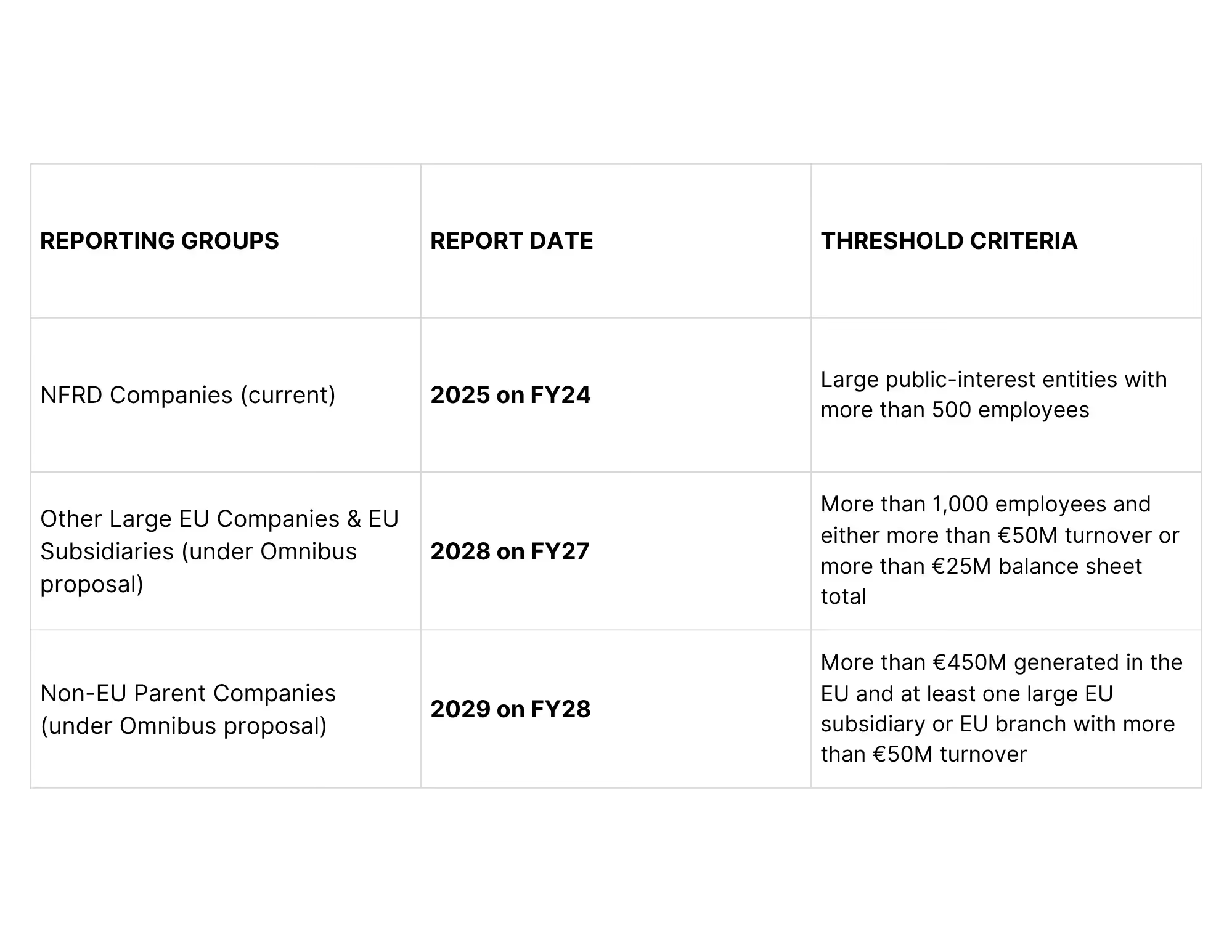
Sources: https://www.consilium.europa.eu/en/press/press-releases/2025/03/26/simplification-council-agrees-its-position-on-delaying-certain-sustainability-reporting-and-due-diligence-requirements/
https://finance.ec.europa.eu/publications/omnibus-i-package-commission-simplifies-rules-sustainability-and-eu-investments-delivering-over-eu6_en
CSRD requires companies to move beyond reporting as a standalone activity.
It introduces the need for a structured system that can:
Sustainability information must be maintained over time and aligned across systems, rather than assembled periodically. Reported information must also be digitally tagged and prepared for external assurance, increasing the need for structured and traceable datasets.
CSRD extends beyond company boundaries.
Because reporting must cover the value chain, companies need to collect and structure data from suppliers and partners.
This is why supply chains become central to compliance.
Not because CSRD targets suppliers directly, but because their data feeds into the reporting obligations of companies in scope.
Preparing for CSRD requires building a structured approach to data.
This includes defining ESG data points, aligning internal processes, and ensuring that information collected across the organisation and supply chain is consistent and auditable.
Compliance is not only about reporting.
It is about creating a system that supports continuous, reliable disclosure.
Digital Product Passports and CSRD operate at different levels, but rely on overlapping information.
This creates a direct connection between the two.
Product-level information collected through Digital Product Passports can support CSRD reporting requirements related to:
The difference is in how the information is used.
The Digital Product Passport structures and exposes data at product level.
CSRD aggregates this information at company level for sustainability reporting.
In practice, product-level traceability and structured data management can reduce fragmentation across reporting processes and make sustainability disclosures more consistent over time.
CSRD is already in force.
What continues to evolve is how it is implemented.
Recent developments include:
These updates refine how requirements are applied in practice.
CSRD establishes a stable legal framework, but its application continues to evolve through:
Staying aligned with these developments is critical, as requirements continue to become more specific and operational over time.
👉 Explore Renoon’s DPP Newstracker to stay aligned with EU developments and product transparency regulations.


.avif)

.png)
.png)