
.avif)
.avif)
The rollout of Digital Product Passports under ESPR follows a phased timeline across product groups, delegated acts, and technical infrastructure.
Rather than applying to all products at once, requirements are introduced progressively through category-specific delegated acts that define:
For brands, this creates an evolving implementation timeline between 2025 and 2030, with different product groups entering the framework at different stages.
This article is updated as new regulatory and technical milestones are confirmed. Last updated: September 2026.
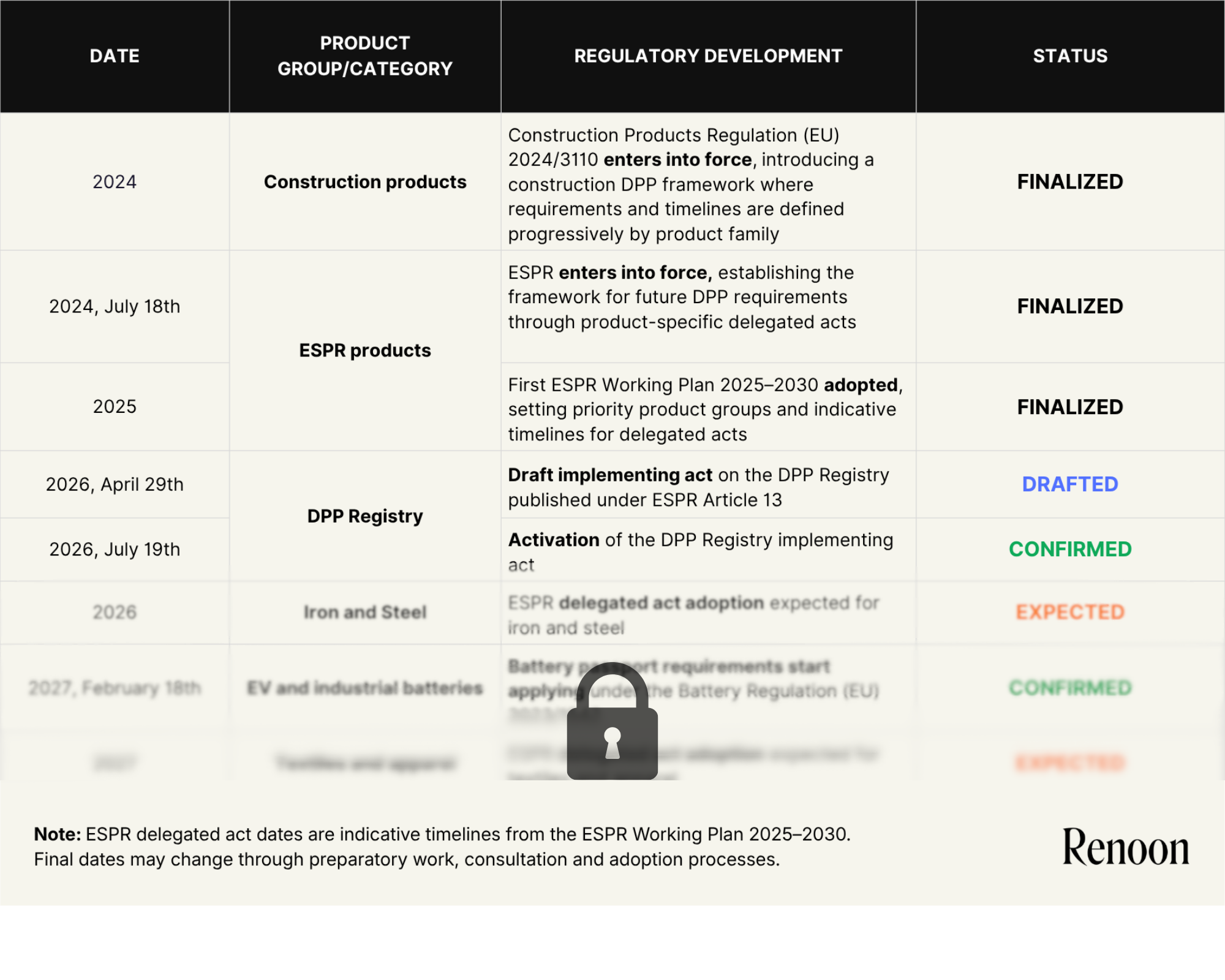
The Ecodesign for Sustainable Products Regulation (ESPR) entered into force in July 2024, establishing the legal framework for future Digital Product Passport requirements across product categories.
At this stage, the regulation defines the framework itself, while product-specific requirements are introduced later through delegated acts.
The first ESPR Working Plan, adopted in 2025, identifies the product groups expected to enter the first implementation phases of the framework.
Priority categories include:
The Working Plan does not yet define the final technical requirements for these categories. Instead, it establishes the expected sequence for preparatory work and future delegated acts.
In 2026, the EU Digital Product Passport infrastructure became operational through the launch of the DPP Registry and the publication of the first European technical standards. Other elements, including the rules for DPP service providers, remain under development.
Commission Implementing Regulation (EU) 2026/1778 was adopted on 16 July 2026, and the DPP Registry became operational on 20 July 2026.
This phase focuses on the infrastructure supporting Digital Product Passports rather than on product-category obligations themselves.
The first mandatory product passports will begin applying in 2027, starting with the battery passport requirements for certain batteries on 18 February 2027. ESPR-based obligations for other product groups will apply only after the relevant delegated acts and transition periods.
This includes:
The timeline differs depending on:
This is why there is no single implementation date covering all products.
The ESPR itself does not define detailed Digital Product Passport requirements for every product category.
Instead, these requirements are introduced progressively through delegated acts.
Each delegated act can define:
This means timelines may differ significantly between product groups.
Several operational layers of the Digital Product Passport framework are now in place, while product-specific requirements and certain implementation rules are still evolving.
Current developments include:
Brands can therefore already identify important structural directions of the framework, even while final implementation details continue evolving across product groups.
For brands, the key challenge is not only identifying future compliance dates, but understanding which operational requirements arrive before those deadlines.
Renoon continuously monitors delegated acts, Registry developments, interoperability work, and upcoming Digital Product Passport requirements across product categories.
If you want to understand how these developments apply to your products, systems, or category, get in touch with our team to learn how the Renoon DPP Newstracker works and request access.




.png)
.avif)