
.avif)
Artknit Studios integrated Digital Product Passports into its product pages with Renoon.
Each item includes supply chain data, certifications, and lifecycle information, made accessible at product level.
This case focuses on how that information is connected to each product and applied consistently across the collection.
Product-level transparency depends on how information is connected to each item.
At Artknit Studios, transparency and supply chain control were already central to how products are developed.
The brand works with a focused network of suppliers and natural materials, with a strong attention to sourcing and production processes.
As the brand scaled, the challenge was not defining this information,
but structuring, validating, and communicating it consistently across products, with a third-party layer.
At product level, information existed but was not consistently structured.
Supplier data, materials, certifications, and lifecycle assessments were managed across different sources and formats.
This made it difficult to connect them to each product and present them in a consistent way across the collection.
The limitation was not access to data, but the ability to use it consistently across products.
The implementation focused on making this information accessible at product level.
The Digital Product Passport was integrated directly into product pages, enabling each item to include:
Before this, this information was not consistently connected to each product or presented in the same way across the collection.
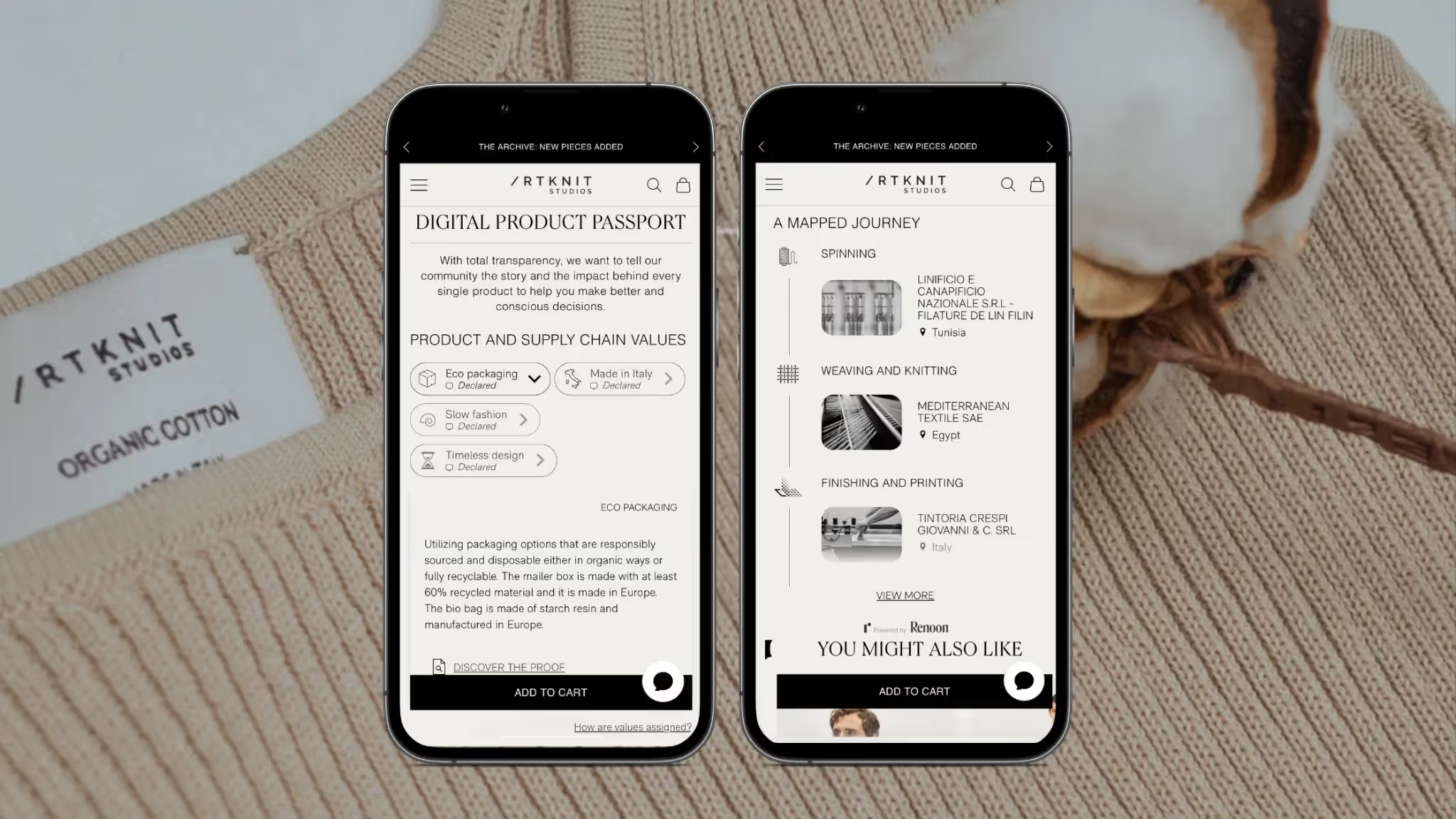
The implementation does not introduce new data.
It changes how that information is connected and accessed.
Each product now carries its own set of information, rather than relying on brand-level or collection-level descriptions.
Information becomes:
The structured data is exposed directly on product pages through the Digital Product Passport.
Customers can access:
This creates a direct link between internal product information and what is visible to the customer.
Users who interact with the Digital Product Passport show improved e-commerce performance metrics.
This includes:
Making product-level information accessible changes how users interact with products.
Artknit Studios’ Impact Report reflects the same information at an aggregated level.
It includes metrics on traceability and material transparency across the collection.
Reporting provides a periodic view across products.
The Digital Product Passport connects the same information to each product and makes it continuously accessible.
This case does not introduce new types of information.
It shows how existing data can be connected, structured, and made accessible at product level.
The Digital Product Passport is not only a communication layer.
It is the interface of a product-level data system.
Explore how Renoon structures product data to enable Digital Product Passports and traceability at scale.

.png)
.png)
.png)
.avif)